 Posted by
 12th November, 2024
I woke up from my cochlear implant surgery to the familiar sight of the anaesthetist, his wild grey hair spilling out from under a hair net—just as I remembered from before I went under. “Everything went well,” he assured me in Spanish. “Thank you,” I uttered through a dry throat. I felt elated, relieved, and wide awake! I started to process the enormity of what had just happened. This surgery, which I had been waiting for so long, was finally done. I was so grateful.
It was an early start, with my surgery scheduled for 6:50 am. To make sure we arrived on time, my partner and I had stayed in a hotel next to the hospital the night before. Valencia was still recovering from the devastating floods, and road closures made the city’s roads congested. Coming from our quiet village, though, a meal out in the city and a hotel stay was a nice change of pace!
After checking in at the hospital, a woman called my name along with another patient, and we followed her down a corridor. I entered a changing room with the other patient—a slight, friendly Spanish woman, older than me. The kind-faced staff member with short, curly hair asked me if I would understand if she spoke in Spanish. I said I would, but mentioned that I don’t hear well. She then positioned herself in front of us, speaking clearly and using gestures to make sure we understood. She instructed us to change into our gowns and put on hair nets and hospital socks.
While we changed, the curly-haired woman went to speak with our plus ones who had accompanied us. The slight Spanish lady began to ask me numerous questions: “Where are you from?” “Where do you live?” “What kind of surgery are you having?” She told me she lived just outside Valencia, was about to have back surgery, and was feeling a bit nervous. I did my best to reassure her in Spanish that everything would be okay.
The curly-haired staff member returned and asked us to hand over the bags with our clothes to our partners, and we said our goodbyes. I kissed my partner, told him I loved him, and then my new companion and I followed the curly-haired lady down the hallway. We walked side by side in our oversized gowns, chatting quietly and patting each other’s arms for reassurance with every few words.
We were both assigned a bed, and I could see my companion across the room, her eyes closed as she lay. A nurse wrapped a blood pressure cuff around my arm and attached a clip to my right index finger to measure my pulse rate. I focused on my breathing trying to calm myself and lower my heart rate, as I could tell the reading was higher than usual. Breathe in. Hold. Breathe out. The nurse returned shortly, checked the readings, asked me about any allergies, confirmed I had fasted for 8 hours, and made sure I hadn’t had a fever or sore throat in the past few days.
Next, the anaesthetist came by, a man perhaps slightly older than middle-aged with a dry sense of humour. He checked that I understood Spanish, and after I mentioned I couldn’t hear from my left side, he moved to speak to me on my right. There was some noise from the bed next to me—maybe the sound of an electric razor, though I couldn’t be sure. Instinctively, the anaesthetist moved closer to my right ear to speak. “What do you do?” he asked, inquiring about my work. I told him I was a writer. I figured explaining hearing loss coaching in Spanish would be a bit much for me, considering how nervous I felt. “Do you know how much oxygen is in the air we breathe?” he asked. A strange and taxing question given the circumstances. He didn’t wait for a response. “21 per cent,” he said. He then went on to explain that, before administering the anaesthetic, they would give me 100 per cent oxygen to help my body during the anaesthesia and surgery. I appreciated the effort he made to explain, and quickly warmed to his quirky sense of humour. He ended our chat with a gentle pat on my arm and said, “I’ll see you again soon.”
Next, I was wheeled into another room, where a nurse inserted the cannula and attached a hospital identification wristband, on which she put a yellow sticker when I told her I was allergic to penicillin. Soon, I was being wheeled into the operating theatre by two chatty female nurses, One of them greeted me with an exaggerated “hello,” to which I replied, “Ah, you speak English.” She smiled and responded, “Only ‘hello’!” She told me her colleague spoke English, which the other nurse confirmed, saying she knew a little.
Before long, I slid myself off the trolley bed onto a narrow ledge, where I was covered with blankets, and ECG monitors were attached to my chest. The anaesthetist then said it was time for my 100 per cent oxygen, which I began to breathe in. Moments later, I felt a slight sting of the anaesthetic going into my arm.
On waking, after seeing the anaesthetist’s familiar face, I was then wheeled through brightly lit hospital corridors and taken back to the room where I had first met him. My bed was parked in a bay, and I lay there trying to take in everything around me. A machine was measuring my blood pressure every few minutes, and I was shaking slightly. I later learned that this could be a side effect of the anaesthetic or simply because the operating theatre needs to be kept cool, which can lower body temperature and make you feel cold. With time, the shaking calmed down and eventually stopped and I began to feel warmer.
As I regained full awareness, I tried gently moving every part of my body to check everything was ok. All good. I paid attention to the taste in my mouth, which though not so pleasant after surgery, didn’t seem metallic, which can sometimes occur after having cochlear implant surgery. I noticed some numbness at the back of my tongue. I touched my face, and there didn’t seem to be any loss of feeling—something that can sometimes occur after the surgery.
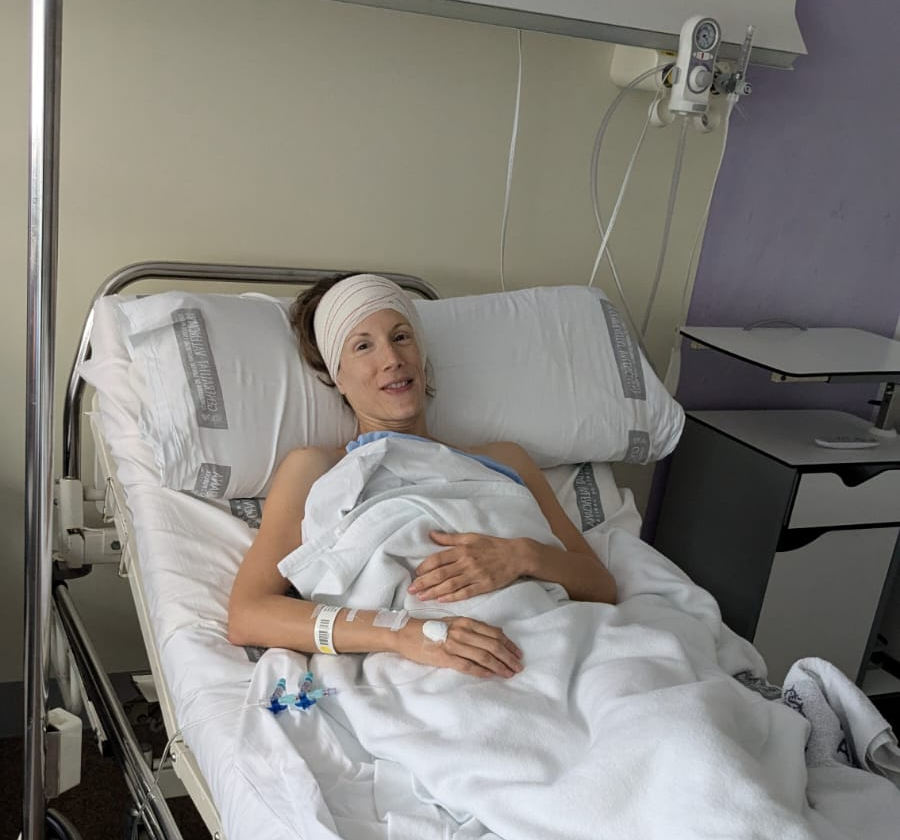
My tinnitus sounded the same, a gentle whirring I had grown used to over the years. I was thankful that the room wasn’t spinning and there were no signs of vertigo, which can also be an after-effect of the procedure. I reached up to my head, which felt like it was being squeezed, and sure enough it was, by a bandage that was wrapped around tightly, holding what felt like a dressing in place over my ear. The bandage was also pressing against my hearing ear. No matter how I tried to adjust it, it still felt sore. Interestingly, I couldn’t feel any pain in the operated ear itself.
Though my sense of time was probably a bit off, it felt like I had been there for about an hour. I watched other patients being wheeled into the recovery area, and a woman sitting by the window with a laptop spoke to the staff accompanying each patient. I think I heard her mention my name as she spoke into a phone. A nurse came over to take my temperature with an infrared thermometer, aiming it at my forehead and removed the blood pressure cuff. She reassured me that everything was fine and that they were preparing a room for me.
I was then wheeled out of the recovery room and saw my partner walking towards me smiling. It was wonderful to see him and I was so excited to finally be on my way to recovery. I smiled at him from my moving bed and gave him a wave.
My partner followed as we entered a lift, and I was wheeled through more brightly lit corridors, lying on my back and observing the ceiling, though I could sense the busy hospital buzz around me. As we approached the door of a room, my partner exclaimed, “A private room!” The hospital porter said something in response, and my partner, with his natural ability to make anyone smile, replied in Spanish, “What service! Like a 5-star hotel!” I watched the porter’s serious expression soften into a smile.
My bed was parked in the room, and I was pleasantly surprised to have it all to myself. Previous hospital stays had always involved sharing a room or being in a ward with multiple patients. This felt like luxury! A nurse soon came in to reassure us that everything was fine. She explained I would be allowed to drink water in 3 hours, and that I could eat shortly after. I was a little surprised by this, as after other surgeries, I had been allowed to drink water immediately. I guessed it was just a difference in hospital protocol depending on the surgery.
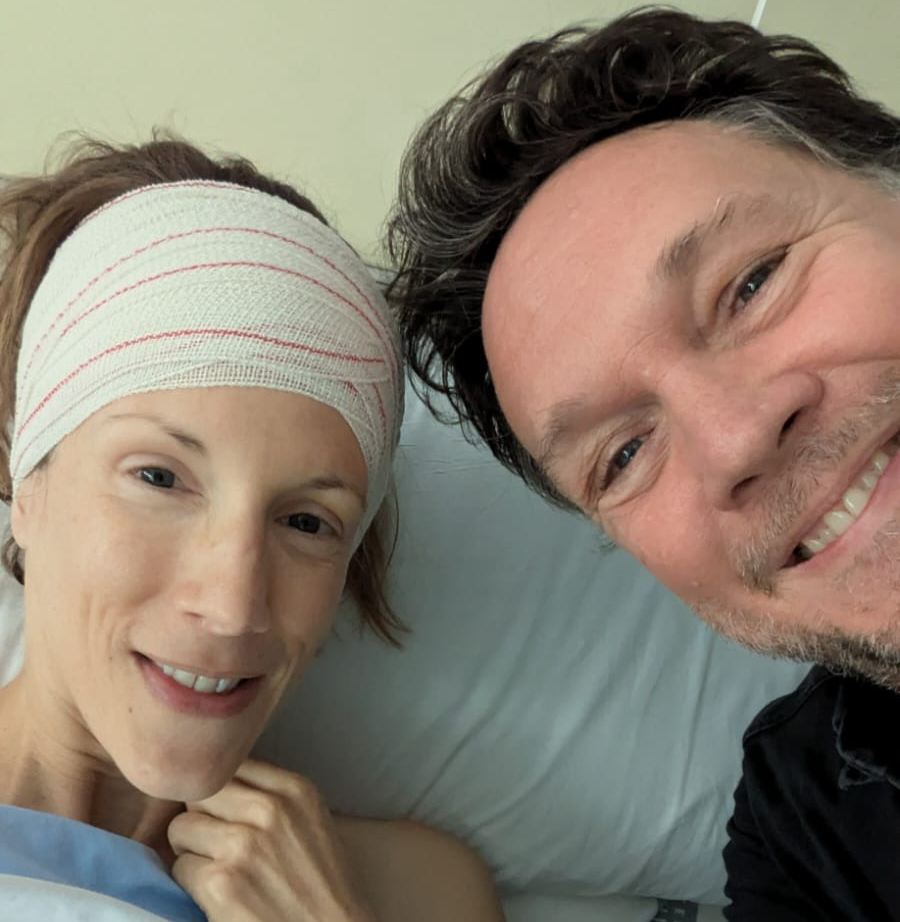
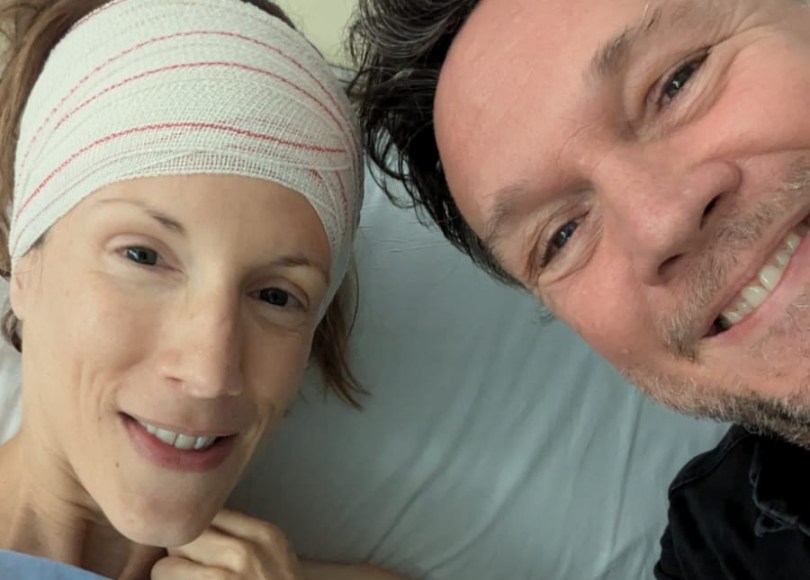
I was just happy to be with my partner, with nothing to do but rest and recover. The nurse told us that, if all went well, I could go home the next morning after the surgeon had visited. I asked the nurse to raise the head of the bed so I could sit up a little, and she joked that the beds were old, as she manually adjusted the lever to lift the top end. She then left the room, and my partner took a quick selfie of us to send to friends and family.
In the afternoon, I started experiencing nausea. It was that familiar queasiness you get as a car passenger, when you need to pull over for fresh air or to be sick. After I threw up some strange green substance, probably bile (sorry for the overshare!), I felt a little better—at least for a while—before the nausea crept back in. A nurse came in and gave me some intravenous anti-nausea medication, which helped for a short time. I also asked for pain medication as my head was starting to throb, which I suspected was contributing to the nausea.
My partner lay down on the sofa bed and he put on an episode of “Desert Island Discs” on his phone. We both closed our eyes, listening to the lead guitarist of Dire Straits, Mark Knopfler, sharing his life story and the songs that meant the most to him. I drifted in and out of light sleep, occasionally hearing my partner snoring gently from across the room. A while later, the nausea came back, and again I was dry heaving, which caused me some worry, as one of the nurses had told me to try and avoid being sick as it wasn’t good for my ear. This worry didn’t seem to be helping the nausea!
When I was finally allowed to eat, I couldn’t even consider drinking the milky coffee they brought me, along with some simple biscuits. I am not a regular coffee drinker and have a sensitive stomach on a good day, so it seemed like a strange choice for someone dealing with nausea post-surgery. In this respect, I am very much English—bring me a nice cup of tea any day! Nevertheless, I managed to nibble on a biscuit, but the nausea soon cut that short. I knew it wouldn’t last forever, and I just had to wait it out. It seemed like a small price to pay for the incredible surgery I had been eagerly awaiting.
In the evening, my meal arrived, and the smell was overwhelming. It seemed like my sense of smell was in overdrive, which might have been contributing to the nausea. I couldn’t bring myself to eat, though my partner encouraged me to take a bite of bread and sip some water. Afterwards, I felt well enough to make my way to the bathroom, IV trolley in tow. I brushed my teeth, wiped my face with a face wipe, and started to feel a little better. I told my partner to head back to the hotel where we’d stayed the night before, so he could order takeaway and get some rest.
Once I was able to have more anti-nausea medication, I was given another IV bag, along with antibiotics and more pain relief. “I hope it helps you feel better,” the nurse said kindly. I finished half the small baguette that had come with my evening meal and drank some mint tea my partner had brought me before he left, glad to have something to settle my stomach.
Later, a nurse turned off the lights in my room and told me to try and rest. I wasn’t quite ready for sleep, so I dozed off and on, with my phone propped on my chest, playing more classic Desert Island Discs. I drifted in and out of Tim Minchin’s life story, Tom Hanks, and David Attenborough. Every so often, I paused to reflect on the moments I was experiencing in that hospital room. This would be a milestone in my own story. What 8 discs would I take with me to a desert island? I wondered.
Sleep was bitty and disturbed as nurses came in every now and then to check on me. Around 6 am I was given more intravenous antibiotics. When I woke up, I felt much brighter. The nausea had eased significantly, which was such a relief, and the numbness at the back of my tongue was gone. After a bit more light dozing, there was a knock at the door, and my partner walked in with a smile. We quickly caught up on the food he’d ordered when he arrived at the hotel and I filled him in on how I was feeling.
A staff member soon brought in my breakfast: more milky coffee, another small baguette, and butter and jam. I was doubtful I’d be able to manage the coffee, but despite its lukewarm milkiness, I drank it, so happy to be feeling better. I also devoured the bread and jam and instantly felt energised and ready to go home.
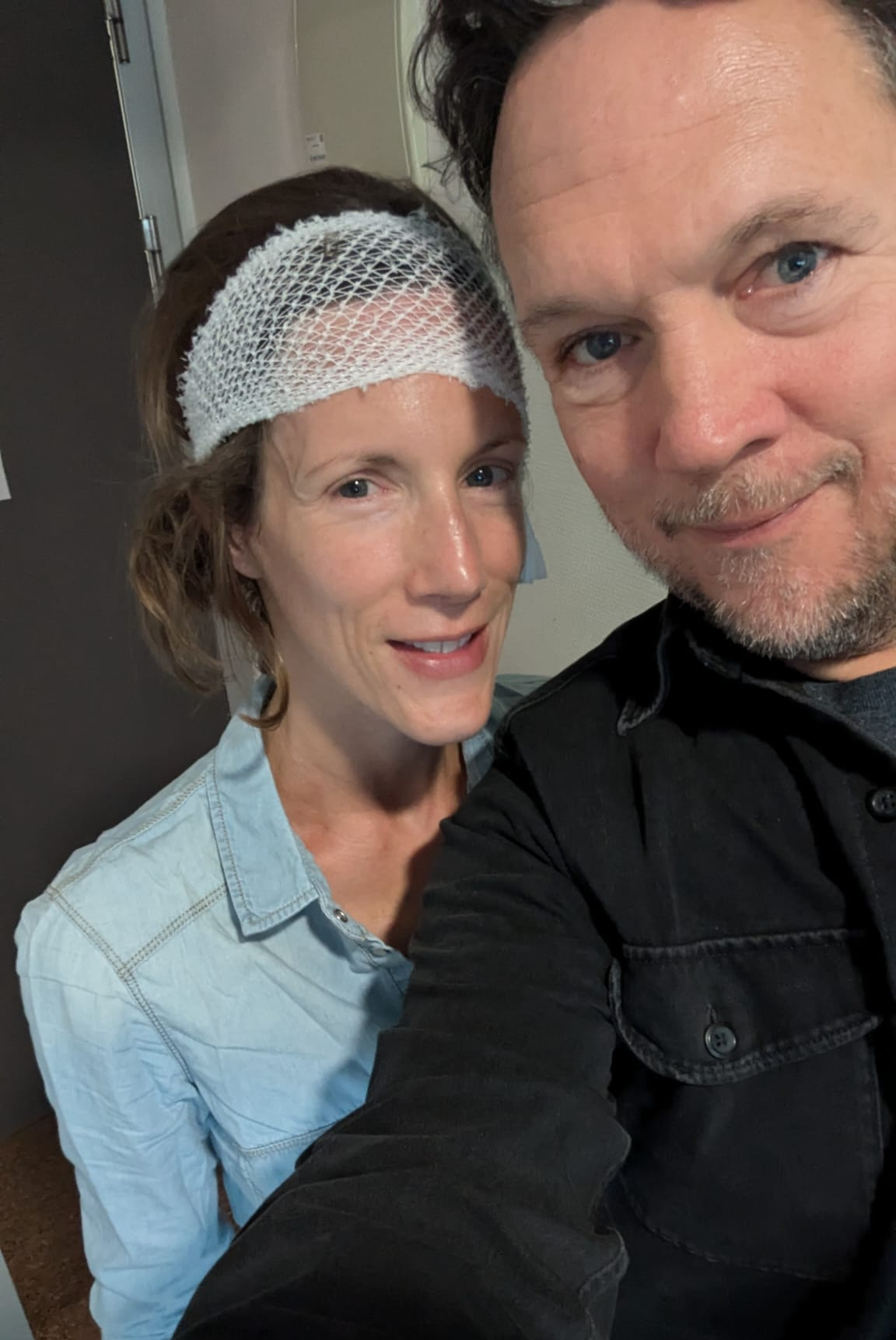
The surgeon came to see me and removed the bandage from my head. The pressure and instant pain release that happened when the bandage was removed one turn at a time felt wonderful! He cleaned and dressed the incision site, and to my partner’s delight, showed him how to do it himself before placing an elasticated band around my head to keep the dressing in place.
I put on the clothes I had arrived in the day before and was especially glad I’d worn a press-stud shirt, which made it easy to dress without pulling anything over my head. It was time to go home.
 My Hearing Loss Story
Oh wow, this brings back memories of my op, seven years ago now. A quiet time next, then on with the exciting stuff – learning to hear again.
LikeLiked by 2 people
Hi Vera, I can’t believe it was 7 years ago when you had your op! Yes, I’ve been having some quiet time. Looking forward to activation day!
LikeLiked by 1 person
Hi Carly, congratulations on the surgery and thank you for retelling your experience so eloquently, I felt I was with you!
I can’t wait to ‘hear’ the next part of your journey.
Rest up and take care, Sandie x
[cid:77389e10-387d-416e-8516-ca10b5ae167c]
Founder: Sandie Dennis (She/Her)
Tel: 07939 916779
Emailsandie@beyondeap.co.uk | Websitehttps://www.beyondeap.co.uk/ | LinkedInhttps://www.linkedin.com/in/beyondeap/
LikeLiked by 1 person
Thank you so much, Sandie! I’m recovering well, and looking forward to activation! x
LikeLike
This is quite a retelling of what were some very anxious moments I am sure! All’s well that ends well as they say, and it’s good to read that you came through like a champ. I’m now looking forward to reading about the learning process as you start back on the road to hearing again! Bless you and your partner for his support too.
LikeLiked by 1 person
Hi Al,
Yes, there were a few anxious moments! Soon, I’ll be learning to hear again!
All the best to you and Patty.
LikeLike
I’m so happy for you! Thanks for sharing the details of your surgery. You had me crying at one point. I’m also so glad that you have a partner that was there to support you though the whole process. I look forward to reading about your audiologist sessions and the activation experience. And, hopefully, you’ll get some tinnitus relief.
LikeLiked by 1 person
Hi Bob, Sorry to make you cry – it wasn’t my intention! Yes, I am lucky to have a good support network and a caring partner. Activation day is December 18th, so not too far away! Wishing you all the best.
LikeLike
Really pleased for you, looking forward to hearing more.
LikeLiked by 1 person
Thanks, Mark! I’ll be sharing regular updates 🙂
LikeLike
What a journey! Thank you for sharing xx
LikeLiked by 2 people
Thank you for reading!
LikeLiked by 1 person
🌞
LikeLike