 Posted by
 The audiologist looked up as I entered the room, greeted me, and asked in Spanish, “How’s it going with the cochlear implant?”
“Really good,” I replied, continuing in Spanish.
“Really good?” he asked, as if needing confirmation.
“Yes, fantastic. I love it!” I emphasized, feeling optimistic and grateful.
“Great,” he smiled, as I sat down and he began typing notes on his computer.
Rehabilitation Activities
He asked if I was having any formal rehabilitation with a speech and language therapist. I told him I wasn’t. He continued typing before asking if I had been listening to words and repeating them, which I assured him I had. Ever the eager student, I’m dedicating time each day to listening exercises. I’ve been carrying out the free activities on the Hearoes app, which I can’t recommend enough, along with the ReDi app which provides more challenging activities, though less visually engaging. I’ve also found another app called English Ear, designed for non-native English speakers to improve their listening skills. It has a simple format where you listen to a word and then choose between two similar-sounding words, like “pray” and “play.” I’m finding it both frustrating and addictive. I keep playing, hoping to progress to the next level by misidentifying fewer than three words. I’m currently somewhat stranded on level 17 of 28.
I’ve also started watching TED Talks on YouTube, using captions to make sense of the bits of speech I catch. The talks are great because they’re usually around 15-20 minutes long, which allows me to focus without losing concentration. Given that my attention span is quite short, regular bitesize rehab sessions seem to work best for me. As recommended on activation day, I continue to listen to music through my processor. I’ve even involved my partner, asking him to play songs from my Spotify and for me to guess the tune. He makes up categories, like “Music from the 90s” or his “classics”—songs he frequently plays or earworms I’m used to hearing him sing snippets of throughout the day.
The Hearing Test
In a small soundproof room, I watched my audiologist through the window as he programmed the equipment on the other side. Opposite me was a speaker. He placed a pair of headphones over my hearing ear, leaving my processor exposed to the sound from the speaker, with the left cup pressing against the side of my face. He explained that he would play the sound of wind in my hearing ear while I listened through my cochlear implant to the sound coming from the speaker. I was instructed to raise my hand each time I heard the familiar beep.
The test proceeded as usual. It was a little tricky to distinguish whether I was hearing through my hearing ear or my implant, but I followed my instincts, raising my hand for every beep I heard or sensed in my deaf ear.
“Great,” the audiologist said as he entered the room. “Well done.”
“Do you think you can repeat some words in Spanish?” he asked.
“I can try,” I replied, knowing that at this stage, even English words were challenging, let alone those in my second language.
He returned to his position outside the room, closing the door behind him. He played loud masking noise into my hearing ear to block out any sounds, and I doubted I’d hear anything over it with my implant. A few seconds passed, and I began to wonder if the test had already started. I looked up at him, and as I raised my head, I heard a sentence in Spanish, I think announcing that the test was starting. It caught me off guard.
I focused my gaze on a spot on the floor in front of me, concentrating hard. Moments later, a woman’s voice said, “Quince”—the Spanish word for the number 15. The sound was clear in my processor, accompanied by a gentle vibration in my deaf ear.
“Quince,” I repeated. I glanced at my audiologist, who gave me a thumbs-up and a grin.
We continued, with some words coming through clearly, even over the white noise. Others arrived as fragments, and I did my best to repeat them—aware that my attempts weren’t always actual Spanish words but hoping they would still provide some insight into my hearing progress. About 20 words later, the audiologist opened the door.
“Well done!” he said. “You’re hearing well!”
Progress and Reflections
We sat back down in his consultation room, and he showed me my results on the computer screen. The usual audiogram (hearing test chart) was displayed, and I recognized the familiar banana-shaped shaded area—the speech banana—where speech sounds typically fall. Before receiving my cochlear implant, the results for my left ear were largely in the 90-110 decibel range, indicating a profound hearing loss. This time, the little blue squares were positioned much higher on the chart. I felt a rush of excitement.
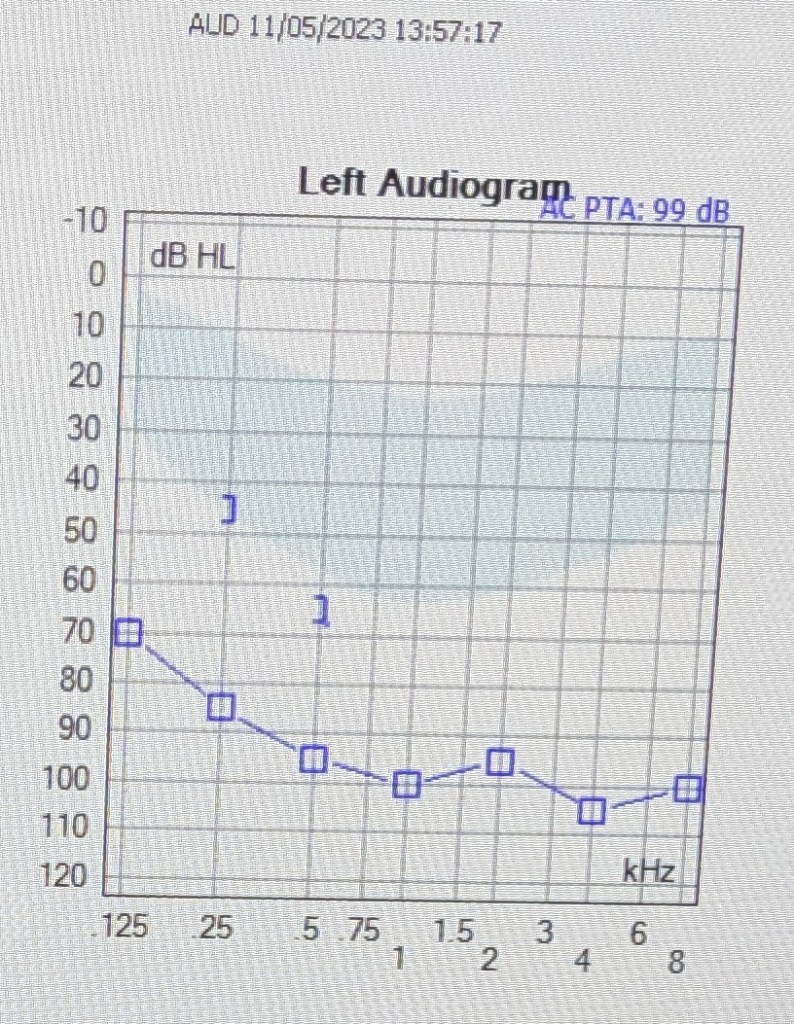

“Our aim is to get results around the 30 mark,” he explained, referring to the decibel levels on the audiogram—a measure of the softest sounds I can hear at different frequencies.
One of my results, at 8,000 Hz (8 kHz)—the highest frequency tested—was already recorded at 25 dB. However, in the lower frequencies, the levels still needed some adjustment. He explained that he would leave the settings where they were for the higher frequencies and focus on increasing the levels in the lower frequencies, where I wasn’t hearing as clearly. He warned that I might experience a sensation of vibration in my head due to the extra bass and that my voice might sound louder at first.
Then, he said something wonderful: “You’re hearing 40 per cent of words, in Spanish!”
He went on to explain that it would likely be closer to 50 per cent if the test had been conducted in English.
40 per cent! Wow!
“40 per cent?!” I repeated, making sure I had understood correctly.
“Yes,” he confirmed, pointing to the mark on the chart. “It’s good progress.”
I felt an uncontrollable grin spread across my face, the skin around my eyes creasing, and I clapped my hands together like a happy seal. Just one month ago, I had zero word recognition. For over eight years, this ear had not recognized a single word. And now, it was already exceeding all my hopes and being an absolute star!
I needed further reassurance.
“Do you think this is good progress?” I asked.
“Yes!” he said. “And after just one month…”
The audiologist then connected my processor to his computer. “You won’t hear anything now; I’m just checking the internal parts of the implant,” he explained. Curious, I leaned over as he turned the laptop toward me. On the screen was a row of 12 dots—one for each electrode— with a line running through them.
“Everything looks good and normal,” he reassured me with a smile.
Next, we repeated the activation-day exercise where I listened to tones and indicated whether they sounded quiet, normal, loud, or too loud. After completing the task, my processor was updated with a new map—a customized programme designed to improve how I hear sounds based on my specific hearing needs. I was given two programmes to take home: I would start with the first one and, in two weeks, move to the second. If the second programme felt uncomfortable after a few days, I was to revert to the first. A follow-up appointment was scheduled for two months.
He told me to keep listening to and repeating words. “And keep listening to music,” he winked. I thanked him, expressing how special it felt to have hearing again in my deaf ear.
“Hearing in both ears is very important,” he replied, smiling.
Thoughts on Comparing Outcomes
Throughout this process, I’ve found myself comparing my experiences to those of others. I think it’s only natural to draw comparisons, especially since the people I “know” going through a similar experience are those I follow on social media and other online platforms, such as blogs, forums, and support groups. Reading about other people’s experiences has been incredibly helpful, yet I’ve come to realize we should each be the star of our own show.
It’s inspiring to see the progress others make with their cochlear implants, but every experience with hearing technology is unique. How well a device works varies greatly from person to person and, to my knowledge, it’s not fully understood. It’s thought that success depends on many factors, such as how long someone has been without hearing before getting the implant. I’ve been repeatedly reminded that the longer the hearing loss, the more challenging it can be to achieve good results. People who still have some hearing before the implant often do better after surgery. Ongoing rehab and staying motivated (which, in my opinion, is key!) also play a big role in how well someone does with the implant.
I’ve read stories of people understanding speech from day one, while others hear only noises and beeps for months. Taking longer to understand the meaning of sounds doesn’t necessarily mean someone will have a less successful outcome—it may simply mean their journey takes a bit longer. If you’re reading this and currently hearing beeps and noises through your processor, that’s a great sign—keep going! Your brain will adapt, and those sounds will start to make sense. Similarly, if you’re already hearing clear speech, congratulations on reaching this exciting milestone!
I’m doing my best not to compare myself to others. Instead, I’m cheering myself on with every song I successfully identify, every environmental sound I hear, and every word or phrase I understand. I’m comparing myself to myself, who up until one month ago had not heard a word in my left ear in 8 years. Right now, I’m exactly where I should be on my hearing adventure.

Enjoying my blog?
Help fuel my writing by buying me a cup of tea!
$5.00
 My Hearing Loss Story
Carly, you are rocking this! Very good news to hear of this early success. Keep on truckin’! It’s fun following your progress (but not having to do all the hard work…ha-ha.)
As for me, of course I would have a 50-50 chance of getting pray or play right on that test but it would be a total guess. In conversation, with context to go by, it would jump up to 80%.
Have a great day.
LikeLiked by 1 person
Thanks, Al! I’m determined this is going to work for me, and so far it’s going better than I hoped. Very happy! I completely know what you mean with regards to words being in context – it’s so much easier to make an educated guess at an unclear words when you know the context of a conversation.
Wishing you all the best!
LikeLike
Carly, thank you for sharing your story!
I’ve been following your blog for a few months now and find it very comforting to hear from someone who’s gone through what I have been going through for years. I started losing my hearing in my left ear in 2016 and was finally diagnosed with Meniere’s disease in 2021. In the last 2 years my hearing in that ear has gone from “significantly reduced hearing”, to “no functional hearing” in my left ear. I find myself no longer enjoying get togethers with more than 2 friends at a time because it takes so much mental effort to understand all that’s being said. Also, the complete lack of directional hearing is beyond frustrating and reading about you turning in the correct direction of a sound for the first time was so encouraging to me!
I’ve finally found a good ENT and in March we will try the CROS hearing aids if the specialized hearing test determines that I’m a candidate, and if that doesn’t work out, cochlear implant is the next step. I’m very encouraged by your experience with CI, so again, thank you and I look forward to your next update!
LikeLiked by 2 people
Hi Nicole, and thank you for your comment. I completely understand when you say you don’t enjoy meeting in large group of people anymore – it’s exhausting trying to follow conversation in these situations.
I prefer to meet one person at a time, though I think this has always been the case, even before my hearing loss. Still, family gatherings can be stressful as they tend to talk over each other – I’m constantly reminding them to speak one at a time! Yes, having some sense of directional hearing has been magical!
That’s great you’ve found a good ENT. I hope you find the CROS helpful, should you try it. Be sure to try it in a variety of listening environments to see how it helps 😉
And, if you decide to go down the CI route, I’m always happy to answer questions.
Wishing you all the best in finding something that helps.
LikeLike
Loved to hear of the great progress you are making! And so admire your take of non comparison with the journeys of other Cochlear implant people. You are a wonderful inspiration to so many . Not sure I’ll ever be able to get one as I’m in Canada and because I do hear ‘fair‘ amount in my non SSHL affected ear with a hearing aide , I do not qualify. Thanks for the lovely update. 🤗
Sent from my iPhone
>
LikeLiked by 1 person
Hi Claudette, and thanks for the lovely comment.
I hope that in the near future, cochlear implants for single-sided deafness will be an available option in other countries such as Canada and the UK. It wasn’t an option here in Spain 8 years ago when I first lost my hearing… I’m sure it’s only a matter of time… Wishing you all the best!
LikeLike
So good to read about your progress, thank you for taking the time not only to share your experiences but to reassure everyone on the journey too. To do all of this in a second language is wonderful. Well done you
LikeLiked by 1 person
Hi Mark! Thank you for reading and your encouragement!
LikeLike
Hey Carly! That is great news! Thanks for updating us on your journey. Interesting that they are turning up the output incrementally. It is hard to explain to others the joy that is felt when you can hear sounds that have been absent. I’m curious if the processor is going to be able to keep up with any advances that may be made? I was just fitted with a pair of Phonak Spheres to help with hearing voices over background noise. I’m still getting used to them but my initial reaction is that their ability to filter out background noise and amplify voice is going to making it much easier to talk to others when my hearing is poor. Doing a bit of a happy dance today as I woke up (without my aids) to some sounds I have not heard in a bit. My hearing is still pretty poor but being able to hear my spouses voice without my aids is my own mini miracle. Hope you have continued success with your implant!
LikeLiked by 1 person
Hi Butch,
That’s wonderful you were able to hear your spouse’s voice without your hearing aids! I can imagine how much joy this must have brought you – happy dances are the best!
I’m pleased you are finding the Phonak Spheres helpful for hearing over background noise – I’ve seen some excellent reviews for them. I will have the same processor for around 6-7 years, I think. I’m sure technology will have moved on a lot since then, but I appreciate whatever technology I have, and then when I get upgraded, it will be even better. There will always be new tech coming out – it’s finding the best balance between cost and current available tech.
Wishing you all the best, and thank you for your support on this journey.
LikeLike
Hi Carly, it is great to find your blog and learn from others about their CI experiences. Recently, I was evaluated for a cochlear implant and have qualified for surgery in a few months. I would be curious what the transition from hearing aids to implants is like. It would be good to connect with others who made the transition.
I look forward to reading more about the advances in hearing technology and healthcare from your blog.
Shanna Groves
http://LipreadingMom.com
LikeLiked by 1 person
Hi Shanna,
I’m pleased you’re finding my story helpful, Congratulations on getting approval for a CI – I wish you all the best with this. For me, I am super happy with my decision 🙂
If you are interested in connecting with others to learn more from personal experiences of transitioning from hearing aids to a cochlear implant, perhaps consider searching on Facebook for a support group for people with CIs. I am in a group specifically for people with single-sided deafness and have CIs – it’s been helpful reading about other people’s experiences.
LikeLike