 Posted by
 I can’t believe it’s already been 3 months since my cochlear implant was activated. It’s become such an integral part of my life now. These past few months have been filled with small milestones, some frustrations, and have demanded plenty of mental energy.
Notes on Rehabilitation
After my one-month mapping session, the new sounds took me a few days to adjust to. Initially, they seemed a little less clear, but soon enough, my brain caught up with the changes.
I’ve continued dedicating time to my rehabilitation exercises and have even added some new activities to my rehab repertoire.
ReDi App
With automatic updates to the Med-El ReDi app, a new program called “Hear at Home” was introduced, consisting of four modules. Since I began these activities after my one-month mapping session when I had already made some progress with word recognition, I found the early modules (focused on recognising numbers, days of the week, and simple words) pretty easy. However, the later modules, which focused more on sentence building and distinguishing between similar-sounding words, proved to be a bit more challenging.
One feature I particularly liked in all the modules was that the instructions weren’t just written; by clicking on a speaker icon, I could listen to the instructions for each activity. I found this to be great listening practice, first listening to the short, simple instructions, and then checking the text to see if I had understood correctly. I’m hoping the ReDi app continues to update with more activities that increase in difficulty.
Hearoes App
On the Hearoes app, I tend to play each game repeatedly until I score 100 per cent—this can often take some time! One of the activities, called “Vowel Mixup,” focuses on mastering the characteristics of vowel sounds. In this game, about 10 balloons appear on the screen, some red and some blue, each displaying a word that begins with “H” and ends in “d,” such as “Hod,” “Hoed,” “Hawed,” “Hood,” “Heed,” and “Hid.” The player is instructed to listen to a spoken word and tap the balloon with that word to pop it. I haven’t scored 100 per cent yet, as the words sound so similar. But I am spurred on in this game by the satisfying sound of balloons popping when I identify a word correctly. And, at the end of each round, all the balloons pop in succession—an almost addictive sound, that I relish every time!
Word Success App
I also discovered the Word Success app, which is made by Advanced Bionics, another cochlear implant manufacturer. Despite having a Med-El cochlear implant, I was able to sign up for the app and benefit from its features. The app offers increasing levels of difficulty, and you can track your progress over time. Each task is simple: you listen to a spoken word or sentence and then select the word(s) you hear from a list of four options. There’s even an option to do this with a friend, who sits beside you and covers part of the screen, hiding the word they are speaking.
I’ve found this app, along with Hearoes, particularly helpful for identifying letter sounds, which I sometimes struggle to differentiate. Over the last two months, I’ve completed all the exercises, though I keep repeating the final one since a passing score is 80 per cent, and I’ve only managed to achieve that a couple of times. I’ve definitely guessed my way through some rounds! One feature that I plan to explore soon is the option to complete exercises with background noise, which will be a challenge for me at a later stage.
TED Talks and Podcasts
I continue to watch TED Talks on YouTube with captions, and just a second ago (while Googling as I am writing this post), I realised there’s a dedicated TED Talks app that also includes captions! I’ll be trying it out in today’s rehab session. Watching TED Talks has been a mixed experience. Some days, I have to rely heavily on the captions, especially when voices sound faint or audibly pixelated. On other days, I can follow a sentence or two without the captions, although I often check them quickly before they disappear to ensure I’ve understood correctly. The clarity varies depending on factors like the speed at which someone speaks, their gender (male voices tend to be easier for me to decode), how clearly they speak, their accent, and how tired I am.
Speaking of accents, I was watching a talk recently and thought, “It sounds like the speaker has an Australian accent.” Just as that thought crossed my mind, the camera panned out to reveal a “TEDx Melbourne” sign. I felt quite proud of myself in that moment!
I am now also able to follow along with podcasts. I have found that many podcasts on Spotify also carry a transcript, which has allowed me to enjoy my favourite storytelling podcasts while reading along. Like the TED Talks, the clarity varies depending on the factors I mentioned earlier.
Tricky Sounds
There are some letter sounds I find particularly difficult to distinguish. Here are a few that continue to challenge me:
- “m” and “n”: Words like “comb” and “cone” sound identical, as do “sane” and “same.”
- “f” and “p” at the beginning of a word, along with “l” and “r” in the middle. For example, “fly” and “pry” sound the same.
- “d” and “g”: Words like “thugs” and “thuds,” or “doubt” and “gout” sound very similar.
- “i” and “oo”: Pairs like “will” and “wool” or “bricks” and “brooks” sound almost identical.
- “v” and “b”: Words such as “verb” and “verve” sound the same.
At this stage, I am not worried about these challenges. I know it takes time to get the best out of a cochlear implant. I just need to keep working to retrain my brain.
Speech in Daily Life
Though I am hearing speech better when streaming, I don’t yet feel like I’m picking up voices in everyday life, since my hearing ear still seems to be doing all the work. That’s not surprising, considering it has been solely responsible for my hearing for the past eight years. I know my processor is currently set to only pick up sounds if they are quite loud, since my audiologist wanted to avoid overwhelming my brain in these early days. However, when I consciously focus on what I hear through my implanted side, especially when watching TV, I realise I am picking up some speech, though it’s not always clear. I aim to start plugging my hearing ear more at home, so I can focus more on deciphering the audio information I am receiving through my implant. I also want to get my partner more involved by having him speak simple sentences on my implanted side to see if I can understand him. Step by step.
Music
Following my audiologist’s recommendation, I continue to listen to music and have reached a point where I can usually identify any song my partner plays from my Spotify app to my processor (as long as I’m familiar with it!) It’s an incredible feeling when I catch onto the beat of a song and guess what it is before the vocals even start. Though music still sounds bare, basic, and fuzzy, I’ve noticed that vocals are much clearer than before. They no longer sound as helium-influenced, though they still have an alien-like quality.
One Sunday morning, my partner and I were at a local market where a live guitarist and singer were performing. Being outdoors and with only two instruments, I didn’t find the music overwhelming. I remember visiting this same market before my cochlear implant and needing to put my finger in my hearing ear because the sound felt too loud. This time, I didn’t have that experience. Maybe my cochlear implant is helping reduce my noise sensitivity, or maybe the music was just quieter. Either way, I have missed live music. It was a passion of mine before my hearing loss, so it felt incredible to feel the music dancing through my ears and body again.
Earlier today, I was sitting in our local bar, enjoying an almuerzo—a traditional mid-morning meal in the Valencia region of Spain that serves as our early lunch once a week. The bar was nearly empty, and the radio was filling the space with classics from the ‘80s, ‘90s, and 2000s. Suddenly, something seemed to click in my brain. The music sounded clearer, and I could hear it more prominently on my implanted side. Britney Spears and then Michael Jackson were singing in both my ears. Music in stereo! The quality through my processor wasn’t as rich as on my natural hearing side, but still, hearing music in both ears was a wonderfully special moment and another sign that my brain is adapting to this new way of hearing.
My next goal is to start more focused music rehab using the MedEl Meludia music training program, which is available to anyone with a myMED-EL account (an online portal that provides access to MED-EL’s digital services). Eventually, I’d also love to try using over-ear headphones over my processor to experience more immersive stereo sound! However, even though I’m very tempted to grab a pair of headphones right now, I’m holding off for the moment because I want to make sure my experience isn’t too discouraging.
Everyday Life in “Kind Of” Stereo
I still have a long way to go on my rehabilitation path, but without a doubt, my cochlear implant is already helping me feel more connected to my surroundings. Even though I can’t yet rely on my cochlear implant for understanding speech in daily conversations, I’m definitely experiencing a richer auditory world.
In our quiet village, a walk down a country road envelopes me in birdsong. In this blog, I wanted to express my love of a much more original sound than birdsong since it’s something nearly everyone with new hearing technology mentions, but honestly, I can’t think of anything more magical than birdsong in stereo (though the sound of popping balloons in the Hearoes app comes close!) The tweets, chirps, whistles, and trills no longer sound robotic, and hearing them so clearly, in full stereo, fills my heart.
I find myself removing my processor in different situations to compare how things sound with and without it. In the car, with my partner driving, we’re listening to music. I lift off my processor to compare. I immediately feel like I’m back in my half-bell jar, where my deaf side feels blocked and isolated. The instant I put my processor back on, I feel more present and included in the moment.
Where Sounds Are Coming From
The ability to identify the direction of sounds disappeared the moment I lost hearing in my left ear—something that requires two working ears. But, slowly, it’s starting to return.
There have been a few occasions where I’ve surprised myself by pinpointing the source of a sound. At the Sunday market, during a pause in a song, I suddenly turned to my left, drawn by a high-pitched noise that caught my attention. My eyes landed on a market stall displaying dreamcatchers adorned with beads and bells, tinkling in the light breeze. Another magical moment.
Adding a Little Bling
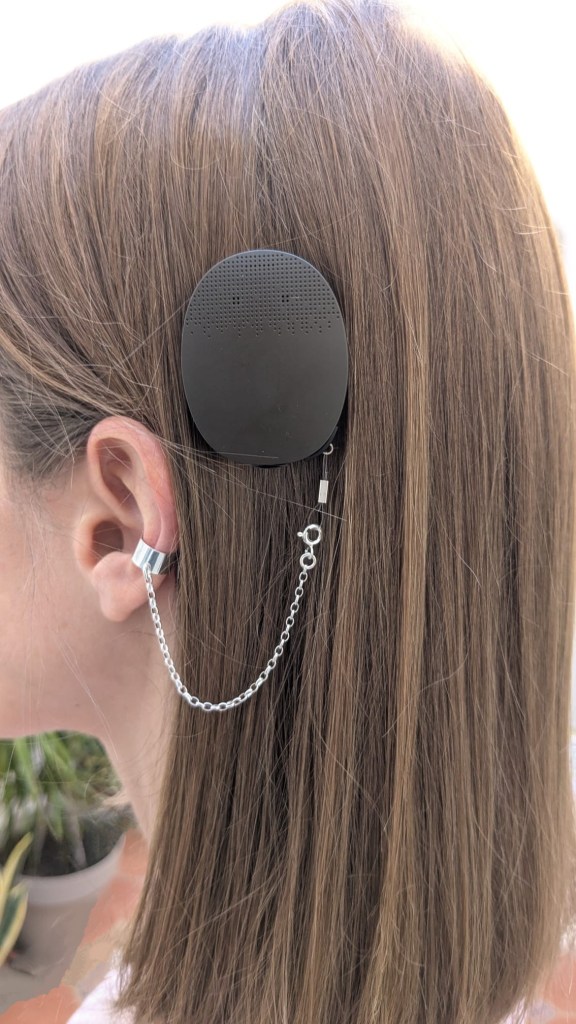
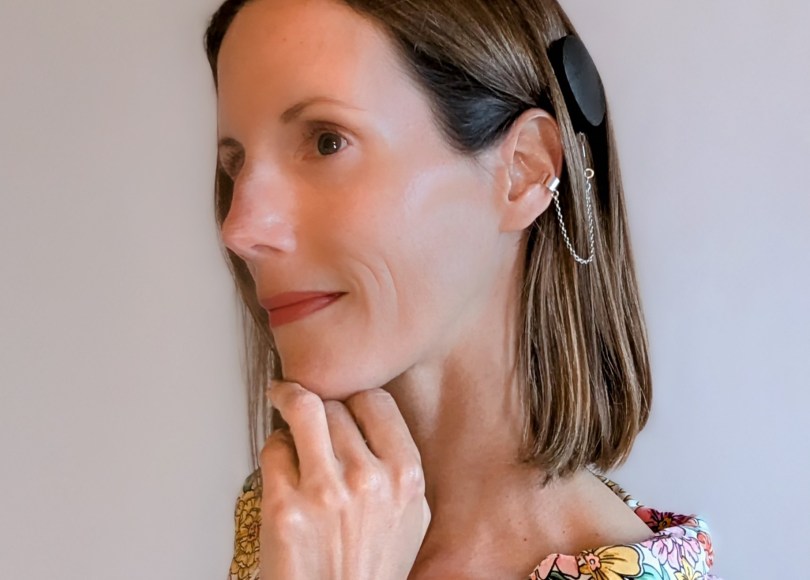
As well as learning how to make sense of sound through the implant, I’ve also started to accessorize with my wonderful safety cuff and chain from DEAFMETAL®, a Finland-based company specializing in hearing device jewellery and safety solutions. I’ve worn it every single day since receiving it. I love it. Though I’ve mostly gotten used to not knocking off my processor, I can’t say the same for my partner, who seems to dislodge it every time he even comes close to me! Thankfully, the safety cuff ensures that if my processor does fall off, it won’t hit the floor—it simply hangs safely from my ear until I put it back in place. These accessories also make me feel even prouder to show off my new ear. I feel like I’m fully embracing my deaf identity.
A funny thing happened when I first took my new accessory out for a spin. My partner and I went to pay a bill at our local plumbers. After speaking to the receptionist and sharing our details for the invoice, we stood up to leave. “You have an implant?” she asked, having noticed my ear while we were talking. “Yes, it’s a cochlear implant,” I replied, excited that someone had finally asked me about it. “Me too!” she said. She allowed me to move aside her thick, curly hair, revealing a small bone-anchored hearing aid (BAHA) tucked away underneath. She told us she’d had hearing issues since childhood and how the bone-anchored hearing aid had helped her lead a normal life—she speaks four languages! She gave me lots of tips and ended the conversation by saying if we ever needed anything, to just ask her.
While I’ve connected with hundreds of people online with hearing implants, this was the first time I’ve connected with someone in real life. Had I not been showing off my hearing loss, this conversation never would have happened. I prefer to highlight my hearing loss as part of who I am, and in doing so, I’ve found that even in this small Spanish village, there are at least two of us with hearing implants! Not only is this little piece of jewellery helping me embrace my hearing-loss identity, but it’s also helping me connect with others in the hearing-loss community.
If, like me, you love the Deafmetal jewellery and safety pieces and want to pick up something of your own with a little special offer, head over to their website and use the discount code (campaign code) at checkout: CARLY15
Keep Celebrating
To my readers on their own cochlear implant adventures, I want to share a tip for staying motivated and confident: celebrate every milestone. Throughout this experience, I am making sure I celebrate each step forward as I move closer to better hearing.
In one of my daily TED Talks entitled “Six Behaviours to Increase Your Confidence” by Emily Jaenson, the speaker, a leadership and confidence coach concluded her talk by sharing her sixth behaviour tip: Celebrate constantly. “How often do we reach our goals and then immediately move on?” she says. “When we do this, the recollection of that success is diminished.” “How can we confidently move forward if we can’t remember what we achieved.”
She encourages us to find ways to celebrate that are meaningful to us. It doesn’t have to be anything extravagant—unless you want it to be! Just something to mark the milestone.
So, what does celebrating look like for me? Well, I enjoy sharing my milestone news with friends and family, taking some time off in the morning and going for a walk in the countryside or a bike ride, enjoying a glass of wine in the evening, baking a sweet treat, or even taking the time to write a blog post every now and then to record these key moments.

Enjoying my blog?
Help fuel my writing by buying me a cup of tea!
$5.00
 My Hearing Loss Story
4 comments