 Posted by
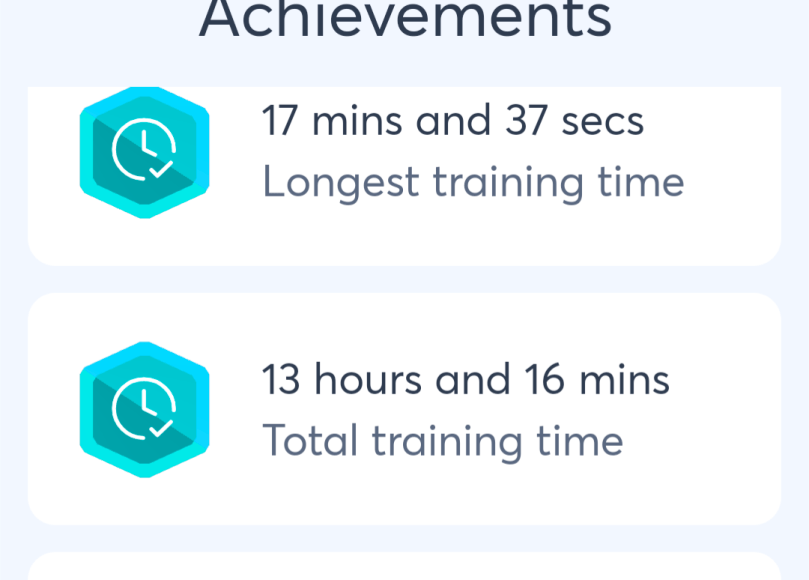
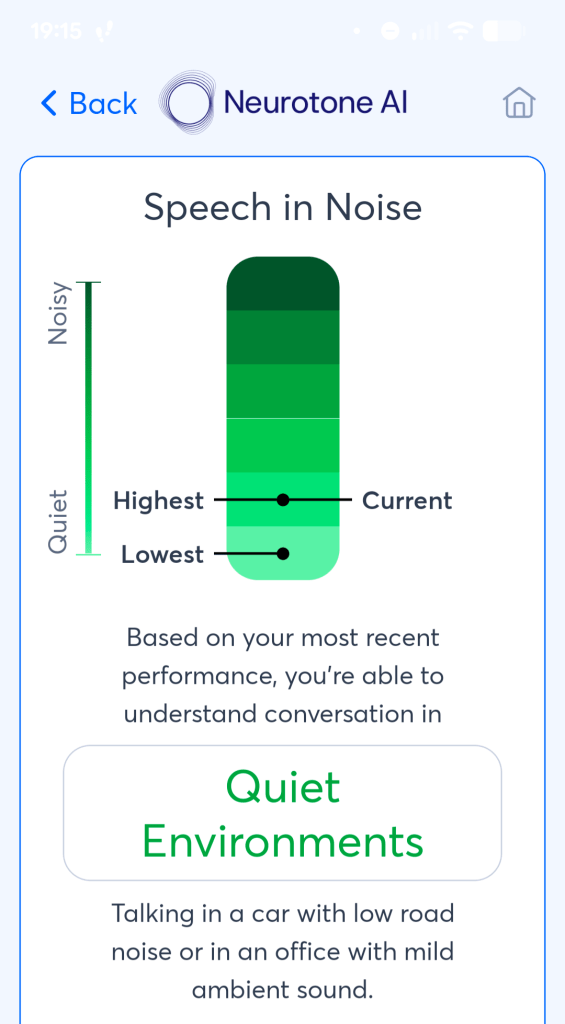
 After 13 hours and 16 minutes carrying out 2,039 exercises, along with a few necessary naps, I have finally progressed from being able to understand conversation in Very Quiet environments (having a conversation in a quiet room, where there is minimal background noise) to being able to understand conversation in environments described as Quiet (talking in a car with low road noise or in an office with mild ambient sound).
It’s a milestone that may not seem impressive, but it’s actually huge for me. I’ve been doing auditory rehabilitation for around 13 months, and though progress is now slower than in the early days when I first accessed sound after getting my cochlear implant, I’m still working on getting the best out of my cochlear implant and am still noticing improvement.
Hearing in background noise is my nemesis, as those of you with hearing loss will relate to. Trying to hear a conversation in a bar or restaurant, or anywhere with background noise, can be mentally exhausting. Not only are our ears and brains trying to listen to the audio, but we are also trying to focus on the sounds that we are able to pick up and merge them together with lip patterns, facial expressions, and tone, to make meaning and try to keep up in a conversation.
Auditory rehabilitation takes energy. It’s an effort. It’s for warriors. It’s not always fun or easy, and sometimes it takes a strong mind to get going. After hearing loss or getting a hearing device, listening is no longer a passive action, but very much a task that demands focus. Learning to hear again through a cochlear implant and carrying out focused rehab can be draining and disheartening, but also promising and positive when you start to notice even the littlest of improvements.
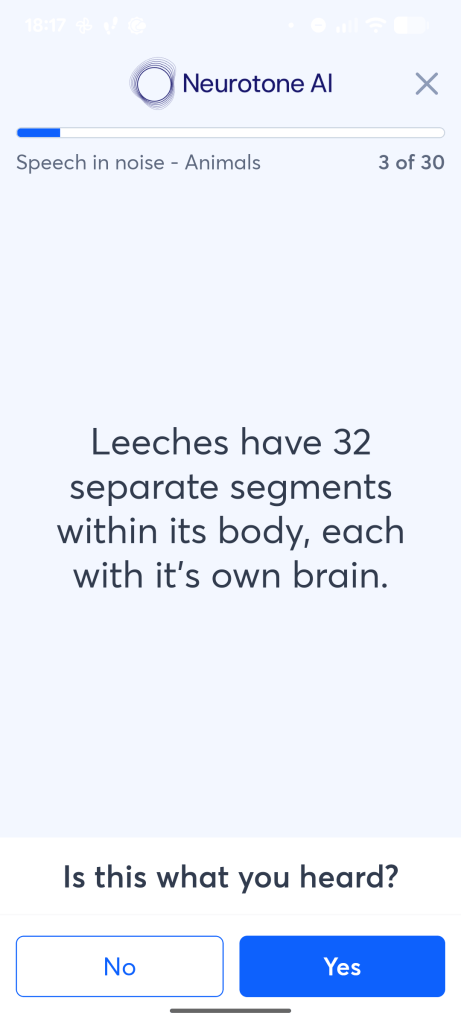
The app that made me aware of my progress listening in background noise is called Lace AI Pro. I wrote about this app in my 6-Month post-activation blog post. Basically, I use the app for the Speech in Noise auditory rehab function. The app has a range of topics you can choose from for the speech snippets, like “Culture and Exploration,” “Fun Facts and Oddities,” “Health and Wellness,” and “Jokes.” Quite simply (or not so simply, it turns out), you listen to a speech snippet on a chosen topic, spoken in background noise, and then are shown what has been said in writing, and you are asked whether or not it matches what you heard.
The Lace app is by far the most challenging rehab I do, as it puts me in a space with background noise and tests how well I can hear. I can feel my brain working hard to make sense of the audio. When I finish, my brain energy battery is noticeably depleted.
There are 30 of these speech snippets per session, which takes around 15 minutes to work through. I had been stuck in the Very Quiet section of the progress bar for around 6 months, and every day I would check to see if I had progressed to the next level. Each day I carried out the listening activities, hoping to have moved up a notch, and today I had!
At the beginning of using the Lace app, I couldn’t distinguish between speech in noise and the background noise itself. The first time I used the app, I generally answered “no” every time I was asked the question “Is this what you heard?”, which is asked after each snippet of audio. But I trusted in the power of my brain that has got me this far in my hearing loss and hearing gain journey. I knew it had the power to adapt, evolve, and start making sense of these new sounds.
Now, my mind is beginning to join the dots, to scoop out the words from the background noise and give them more focus.
The Lace training is just one activity of a pick and mix of rehabilitation activities in my toolbox, including listening to music on Spotify, deciphering WhatsApp voice notes from friends and family, watching TED Talks, listening to podcasts or an audiobook, and carrying out activities on other gamified auditory training platforms, such as Hearoes. Sometimes I do a little of all, and other days I focus on one aspect of listening.
I know that auditory rehab is helping. I’m starting to notice the improvements in everyday life. I now sometimes ask my partner to stand on my deaf implanted side when we walk, and I listen to him through my cochlear implant. I am able to pick up quite a lot of the conversation, and after eight years of living with single-sided deafness and developing some superpowers along the way, I can fill in most of the gaps. Recently, I noticed that conversation with three other people in a restaurant felt a little easier, the effort a little lighter.
In writing this post, I want to bring attention to the fact that hearing rehab demands so much commitment and concentration. Even looking up from my phone, where I carry out all my rehab, and letting my mind wander to something as simple as the room around me breaks my focus. I find myself staring meditatively at my phone screen, willing my brain to focus on nothing other than the sounds being streamed to my implant. I even used to find I was holding my breath for every few seconds of listening effort during each exercise.
And if there’s any other background noise, a car driving past our living room window, or my partner making even the slightest noise in our echoey open-plan living and kitchen area, the concentration and ability to make sense of sound short-circuits. This has, at times, led to me getting annoyed at him for simply getting a glass of water or opening a cupboard door.
So, my milestone today is something I am proud of. It is something I have worked hard at. It’s something that has given me a boost, spurring me on to keep going. It might not seem like a lot, but I hope this post brings some encouragement to anyone out there who feels like rehab is a battle they are struggling with. Keep going! Small baby steps are still moving forward.
Supporting Others on Their CI Journey
As many of you know, I’m a hearing loss coach. I support people in various aspects of life with hearing loss. More recently, I’ve added a new service focused specifically on one-to-one support for people going through their own cochlear implant experiences. This can include helping you prepare for surgery, adjust to life post-activation, stay motivated with rehab, or simply having someone to talk to who understands the ups and downs of the process. If you’d like to learn more or get in touch, you can find details here.

Enjoying my blog?
Help fuel my writing by buying me a cup of tea!
$5.00
 My Hearing Loss Story
Congrats on your improvement! I’ve tried Lace AI and I really like being able to use the voices of people you know to help with your rehab. I need to be as dedicated to the app as you are. With my fluctuating hearing loss, when my hearing is “better” I lose motivation for the app as my speech recognition improves so much on its own. I have a friend who has just started on the same journey as you. Single sided deafness for years and just got activated! We are very excited for her. One of the challenges she has mentioned is being able to pair with her phone to listen to music while running so that she can stream to both her cochlear device and an air bud. Is this something you have worked through? All the best!
LikeLiked by 1 person
Hi Butch! Thank you so much for the encouragement! How wonderful for your friend – I wish her all the best! To my knowledge, thre isn’t currently a way of streaming to both an ear bud and the CI – we have to choose one or the other. The other option would be to find some over-ear headphones that are big enough to fit over her CI processor without causing interference, so that she could listen through both ears. An option for the near future is Auracast – a Bluetooth connectivity technology. In the following article, I talk about how this tech could be a gamechanger for people with SSD who want to stream audio through both an earbud and a hearing device at the same time (see about a quarter way down the article – subheading: More advantages for people with hearing loss): https://www.hearingtracker.com/auracast
LikeLike
Well done Carly – what a milestone! It’s been relentless for you but so great that you have shared all your experience ( good and bad(. You’ve clearly made such a difference to so many people with hearing loss who now feel they’re not alone. Keep up the good work!
Sent from Outlook for Androidhttps://aka.ms/AAb9ysg ________________________________
LikeLiked by 1 person
Thank you for your support and encouragement, Tricia! ❤
LikeLike