 Posted by
I’ve recently been reading about MED-EL’s new TICI UNICO, the world’s first fully implantable cochlear implant (CI). As someone with single-sided deafness who uses a MED-EL CI with a RONDO 3 off-ear processor, I was naturally curious to find out more about this new generation of hearing technology.
The TICI is a fully implantable CI, meaning that everything, including the microphone, is implanted beneath the skin. Unlike a traditional CI, there is no external sound processor. I think it’s amazing that we’re living in a world where this is now possible. A device can be implanted completely beneath the skin, with tiny electrodes inserted into the cochlea, giving someone access to sound, all of this happening out of sight!
It’s undoubtedly exciting technology, and the possibility of giving more people with severe-to-profound hearing loss access to sound, including those who may have chosen not to use hearing devices in the past, is something worth celebrating.
As I’ve been reading about the TICI, I’ve found myself with quite a few questions. I’ve also been wondering how I’d feel about having a fully implantable CI myself, and reflecting on some of the language used to promote the device.
How does the TICI work in everyday life?
One of the exciting things about the TICI is that you can access sound throughout the day and night, even while sleeping, swimming or showering. You can also turn it off if you’d prefer.
The battery lasts up to 40 hours between charges and is recharged using a device called the GoPod, which sits magnetically over the implant. It looks a little like my RONDO 3 processor. Charging takes around an hour, and you don’t lose access to sound while it’s charging. MED-EL says the TICI offers hearing performance comparable to its traditional CIs.
Some questions I have about the TICI
Here are some of the questions and thoughts that have popped into my mind:
- Now that a fully implantable CI is possible, could the same be possible for hearing aids or bone-anchored hearing systems?
- From what I’ve read, the TICI microphone is secured to the bone, which is different from a traditional CI. Does this bring any additional risks in surgery? What are the possible complications, and is recovery similar to that of traditional CI surgery?
- Nobody ever talked to me about the sound of my hair rubbing against my RONDO 3 processor! I wonder what hair or skin rubbing over the microphone area of the TICI might sound like.
- MED-EL mentions that TICI recipients need auditory rehabilitation, just like traditional CI recipients. Is the process much the same? Are there any differences in learning to interpret sound with a microphone beneath the skin?
- What about direct streaming? I’ve used this a lot for my auditory rehabilitation, particularly when listening to podcasts and doing listening exercises. According to MED-EL’s website, TICI users can listen through bone-conduction headphones or over-ear headphones positioned over the implant’s microphone. I wonder how this would work for rehabilitation and whether it would be as effective as streaming sound directly to my RONDO 3.
- What are the most common things that could go wrong with the device, and how would they be fixed? Are these different from a standard CI?
- If someone already has a traditional CI, could they have it replaced with a fully implantable one?
- MED-EL estimates that the internal battery should last at least 15 years under specified conditions, which sounds promising. But what happens when it eventually needs replacing? How often might someone need an upgrade? Would this involve another surgery, and if so, would it be as involved as the original implantation? Could some parts of the device stay in place while others are replaced?
- How might the technology evolve over time? Will future versions become smaller, thinner or offer better features? And if a newer model were expected in the near future, would it be worth waiting? I’d be interested to see how the technology develops as more people begin using it.
These are just some of the things I’ve been wondering about, and questions I’d want to explore if I were considering a fully implantable CI myself. As I’m writing this, even more are coming to my mind!
Hearing in water
One of the things that features heavily in MED-EL’s marketing of the TICI is water. There are videos of people swimming and enjoying water-based activities while continuing to have access to the sounds around them. And I can understand why. For people who wear traditional CIs, water can be a little tricky. MED-EL has waterproof covers called WaterWear, which allow people to swim, shower and enjoy water sports while wearing their CIs. Many people use them successfully, but I’ve never quite felt comfortable taking that risk in the sea.
So far, I haven’t tried swimming with my RONDO 3 covered. I always remove it. I live near the beach, and sometimes go swimming or snorkelling in the sea. I imagine it could be difficult to position a snorkel and mask around my RONDO 3, and I’d worry about knocking it off my head. My partner frequently loses his sunglasses when he’s out paddleboarding, so I know how easily things can disappear into the sea! I’d also worry about the waterproof cover developing a tiny hole, allowing water to get inside and damage the processor. For me, swimming in the sea with my RONDO 3 just hasn’t been worth the risk.
The TICI removes the worry of protecting an external device from water or accidentally losing it. When I first read about this feature on the MED-EL website, I felt fairly neutral. I was reading to gather information and understand the technology, rather than really thinking about the person on the other side of the device.
Then I ventured to the videos further down the page. Oh my goodness. There’s a video of a woman called Sofie swimming underwater, and I found myself tearing up as I watched it. Until that moment, I hadn’t given much thought to what I might be missing when it comes to water. Watching her swimming, I started imagining what it might be like to hear the sounds of the ocean rushing past me, the movement of the water around me, and the shower pattering on my head, not just through my right ear (as I do now when I take off my CI processor), but from both sides. In stereo! With my natural hearing in my right ear and sound coming through a TICI on my left. Oh, that would be amazing!
The freedom of having no external device
Another obvious benefit of the TICI is that there’s nothing on or in your ear. You don’t need to worry about knocking off an external processor or losing it. There’s no external component getting in the way of glasses, sunglasses or hats, which can sometimes be a little awkward. Some people find hearing devices uncomfortable to wear behind their ears, or struggle to find a magnet strength that’s comfortable for an off-ear processor. And, of course, there’s the fact that the TICI is invisible.
With the TICI, someone with hearing loss can access sound without necessarily having to tell the people around them that they have a hearing loss, unless they choose to do so. I can see the benefits of this. I know we don’t live in a perfect world. I know that not everyone views people who are deaf or hard of hearing in a positive light. There are people who feel uncomfortable or even unsafe wearing visible hearing devices in certain situations because of the possibility of discrimination or unwanted attention. I know there are parents who worry about their children being bullied because they wear hearing aids or CIs.
One thing I particularly like about MED-EL’s messaging is that they talk about giving people “the power to choose when you tell people about your hearing loss.”
The language around hearing loss
I know that discrimination and negative attitudes towards people with hearing loss still exist, and I believe this is something we need to continue working to change. I grew up in a world where the word “deaf” was often used as an insult. “Are you deaf?” was something people would say when someone misheard or didn’t respond. And unfortunately, this kind of language continues today. The words we use around hearing loss can play a big part in the way society views it.
So when I came across phrases in MED-EL’s marketing such as “Forget about your hearing loss”, “Leave Hearing Loss Behind” and “Reduced hearing loss stigma”, I found myself questioning what these messages might mean to our community.
I understand what MED-EL is trying to communicate. The TICI removes some of the practical challenges associated with wearing an external hearing device, and for many people, this could make everyday life considerably easier. But does having an invisible CI mean that someone can forget about their hearing loss? Does it mean that listening no longer requires effort, or that noisy environments are no longer challenging?
Even with my CI and natural hearing in my right ear, I still find some listening situations difficult. I still find it hard work accessing conversations in noisy environments, for example. I still experience listening fatigue, and there are times when I need people to make adjustments to help me follow a conversation. My CI has brought so much to my life, but it hasn’t removed every challenge associated with my hearing loss. And while the TICI removes the external processor, to my understanding, it doesn’t necessarily remove the listening effort that can come with hearing through a CI.
MED-EL uses the phrase “Reduced hearing loss stigma”. Does making a hearing device invisible actually reduce the stigma surrounding hearing loss? Or does it allow someone to avoid experiencing some of that stigma? I don’t think these are quite the same thing.
I completely understand why some people would prefer an invisible hearing device, and I think it’s wonderful that this is becoming an option. But I also believe that the more we normalise hearing devices, talk openly about hearing differences and help others understand some of the challenges that come with living with hearing loss, the more we can work towards reducing stigma itself. And so, I feel a little uncomfortable with language that could unintentionally suggest hearing loss is something we should want to hide, forget or leave behind.
I don’t believe this is MED-EL’s intention. In fact, elsewhere on their website, they talk about giving people the choice of when to disclose their hearing loss, which I think is a much more positive message. I also like phrases they use such as “A New Way to Hear” and “a new level of convenience”. To me, these feel much more aligned with what the technology offers.
Would I choose a fully implantable cochlear implant?
Of course, all of this has made me think about my own future as a CI user. If I were offered a fully implantable CI, would I choose it over a traditional one? I’m on the fence about this.
On the one hand, I love the idea of not having to worry about knocking my processor off my head. Being able to wear my sunglasses on top of my head without worrying about dislodging it, and swimming or showering while continuing to hear the sounds around me, would be wonderful. But I also know how happy I was to finally have a visible hearing device.
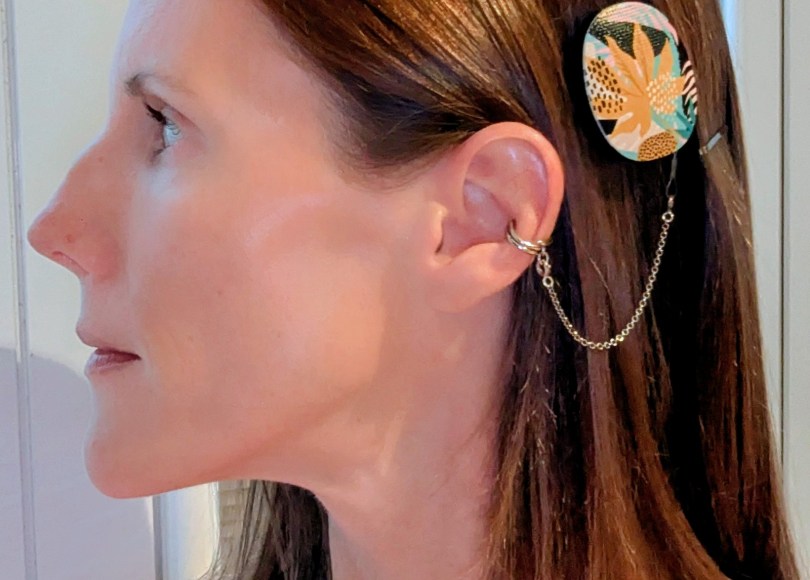
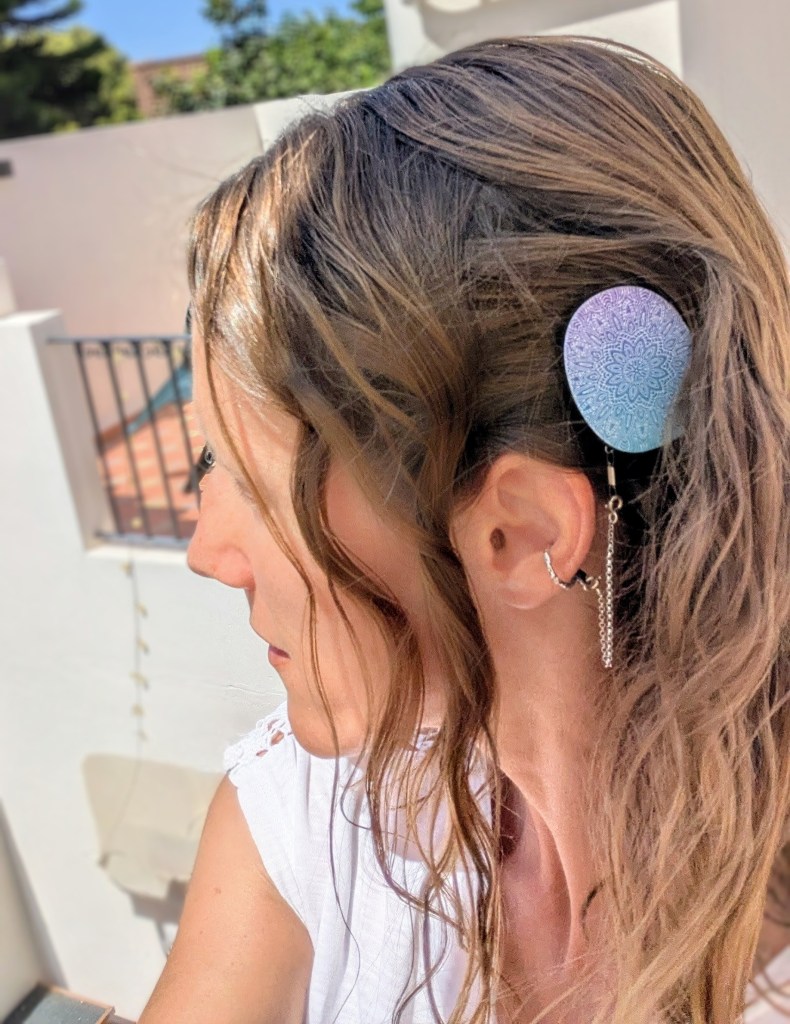
After eight years of living with profound deafness in my left ear, with no visible sign of my hearing challenges, I was actually relieved and excited to finally have a visible CI. I remember how wonderful it felt to have something visible to refer to when I was struggling to hear or understand speech. For example, in situations where communication can be challenging, such as airport security, I can point to my processor and people can see that there’s something going on with my hearing. It’s a visible indication that I might need a little extra understanding. For those closer to me, it’s also a reminder that following conversations doesn’t always come easily to me. And I’m proud to show off my processor. I love treating myself to a new cover design, or a cool piece of jewellery from Deafmetal to make my little robotic ear feel more personalised. I’m happy for people to ask me, “What’s that on your head?”
I love talking about my cochlear implant and how much joy, increased access to sound and feelings of safety it has brought into my life. These conversations help others understand what living with hearing loss can be like. I also feel they can be helpful for others going through similar experiences to feel less alone. I feel these are the conversations that need to keep happening if we’re going to move towards a society where hearing differences and hearing challenges are more widely understood and accepted. Where people understand that someone can have a CI and still experience hearing difficulties. And where having a visible sign of something that makes us unique doesn’t have to be viewed negatively. Why can’t it be celebrated?
A new way to hear, and more choice
Despite my mixed feelings about some of the language used to promote the TICI, I am excited about this new development in hearing technology, and I congratulate MED-EL on such a wonderful advancement.
For some people, having an invisible CI will be incredibly liberating. For others, like me, having something visible can be empowering too. We all have different experiences of hearing loss, different needs and different feelings about the devices we use.
So while I love the idea of a cochlear implant that offers a new level of convenience, I think the real achievement is that people now have another option. Another way to access sound. Another way to make everyday life a little easier. Another choice for people deciding what works best for them. And I think the important word here isn’t “forget”. It’s choice.

