
 Posted by
 “Hi, Carly,” the audiologist called me in Spanish from his consultation room. “How are you doing with the implant?” he asked as I walked through the door.
“Great!” I replied, removing my jacket and sitting down.
Sitting across the desk from him, I looked up and noticed a serious look on his face.
I could feel my heart beating in my chest. I had just arrived at the hospital about 30 minutes before my appointment was scheduled and had expected to wait at least that long. But as soon as I removed my ticket from the machine where I checked in, my number popped up on the screen to go to my consultation room. No waiting time. I was happy to be seen straight away— a rare occurrence— but felt a little caught off guard.
I also felt a little nervous. Perhaps I was a bit worried about how I’d feel if my hearing test didn’t show improvement, especially after such a successful result last time. I know progress isn’t always linear, but I also knew I’d struggle to hear any negative news at this stage. I focused on slowing my breathing as I rummaged through my bag, searching for the notes I had prepared on the letter sounds I had been struggling to distinguish.
Monitoring Progress

As I placed the piece of paper on the audiologist’s desk, I read through the different letter sounds. He reached for some laminated reference cards with groups of letter sounds and other information and proceeded to write down some notes.
Next, he showed me my audiogram from the last appointment.
He pointed to the shaded area—the “speech banana”—the section on an audiogram where the range of frequencies (pitch) and decibels (loudness) of human speech typically fall. “Our aim is to get you to around 30 at all frequencies,” he told me, referring to the decibel hearing levels on the y-axis (vertical) of the chart. Over time, he would adjust the programming of my cochlear implant so that I would be able to hear sounds at 30 decibels. This would mean I would have better access to speech.

“We need to increase it gradually,” he explained, “to avoid complications like noise discomfort or facial nerve issues.” He went on to explain that if the intensity levels are set too high too quickly, the electrodes in a cochlear implant can accidentally stimulate the facial nerve, which may cause unwanted movements or twitching of the facial muscles.
“I’ve been doing listening exercises every day,” I told him, showing him the apps I’d been using. He took a photo of my phone screen, clearly interested.
“These are all in English?” he asked. I assured him they were. I know he also runs an audiology practice, and maybe he has other patients at the hospital whose first language is English.
“Doing this is the most important thing,” he told me, pointing to the apps on my phone, still looking very serious.
“Yes, I’m working hard every day,” I told him, trying to crack a smile.
“Let’s do the test!” he exclaimed, standing up from his seat.
Testing and Tinnitus
I followed him to the soundproof room and took a seat in front of the speaker, with him behind the glass, just like in our previous session.
This time, he placed an earplug in my hearing ear to help me focus more on the sounds coming through my processor. He positioned the headphones on my head so that the right cup covered my hearing ear, and the left cup pressed against the side of my face, leaving my processor free to focus on the sound from the speaker. To make sure we could accurately test my implanted side, he also played a wind sound into my hearing ear.
It was at this moment, sitting in the room, staring at the floor, that I noticed my tinnitus. I have three types of tinnitus: a constant rushing sound in my deaf ear, intermittent ringing or bells in my hearing ear, and a white noise in my head that sometimes sounds like a distant radio or TV. My tinnitus rarely bothers me, but at this moment, it made itself known. Perhaps because I was a little nervous, it seemed more prominent. I glanced at the audiologist through the glass. He nodded at me, and I nodded back.
I focused on the floor again, trying to clear my mind. Then, I heard a “Beeeeep.” Was that a tone from the hearing test or my tinnitus? I hesitantly raised my hand and looked at the audiologist, who shook his head, probably sensing something was off.
Ugh, of course—the one time I really need to focus, my tinnitus decides to go crazy.
I went ahead with the test, raising my hand whenever I thought I heard a beep. When the audiologist returned, he paused for a moment before saying, “I’m going to test you again.”
After a little more testing, he asked if I could try listening to and repeating some words in Spanish. “I’ll try,” I said, just like I had two months ago in the last appointment.
By now, my eyes were burning a hole in the floor in front of me, but I was determined to do my best. A woman’s voice announced that the test was about to begin. “That’s a good start,” I thought to myself, happy I understood what she said. The test involved about 20 words. Some I repeated, knowing they were definitely Spanish words; others I repeated, knowing they definitely weren’t! Still, I did my best to pronounce the letter sounds clearly so the audiologist could get a better idea of my hearing capabilities.
The test was over quickly, and once it was done, my tinnitus seemed to fade back into the background.
The audiologist removed my headphones and asked me to return to his consultation room. As he typed something into his computer and spoke with colleagues in the hallway, I overheard him saying, “She is deaf in her left ear and has a cochlear implant,” followed by something indeterminable but in what seemed like a positive tone.
Revealing the Results
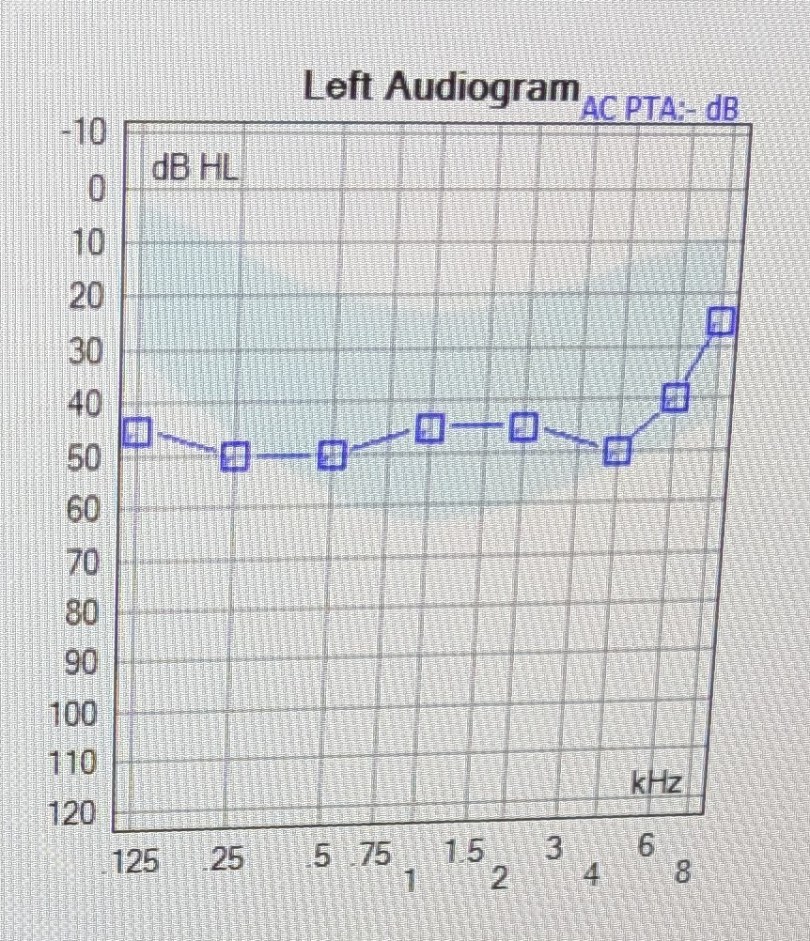
He sat back down in his chair in front of me and showed me the audiogram. My hearing levels with the implant had improved since the last mapping session, and we were getting closer to the 30 mark. My hearing was now in the mild-moderate hearing loss range—such a difference from just three months ago before receiving my cochlear implant, when my left ear results were mainly in the 90-110 decibel range, indicating profound hearing loss. I explained that the beep test had been tough because my tinnitus was loud that day. He nodded as if he had noticed something wasn’t quite right. His demeanour softened, and he seemed happy with the overall results.
“But, this is what matters most,” he said, slowly scrolling down the screen. He pointed to my word recognition score, which had jumped from 40 percent at my last consultation to a whopping 75 percent!
“What?!” I exclaimed, surprised.
I looked up at him, and he was smiling.
Now, I’m aware he may have been generous with the scoring, especially since Spanish isn’t my first language—many of the ‘words’ I repeated weren’t actual words! Also, the words needed to be pretty loud for the test, but that’s nothing to worry about. The implant will gradually be adjusted to pick up softer sounds over time. What matters most is that my brain is starting to make sense of what I’m hearing.
75 per cent!
“This is what’s important,” he reiterated, pointing at my phone again, just as he had earlier, referring to the rehab work I had been doing.
“I’ve been working really hard,” I told him, like a child eager to please their teacher. “I’m super happy!” I said, smiling now, too. And he was smiling right back.
Adjusting for Comfort
Once again, he asked if I had been contacted by a speech therapist, and I told him I hadn’t. He nodded, saying he’d see if it could be arranged. I knew this was something I should have been given access to, but it seemed my name had gotten lost in the system.
“Keep listening to music,” he advised, as he always does. “And print out the lyrics so you can follow along.”
I excitedly showed him how the lyrics are available on the Spotify app, so there was no need to print anything out, which surprised him.
Next, he checked the skin where the processor magnet sits. “It’s a little red,” he observed.
I explained how I sometimes feel pain around the magnet area, and he decided to switch the magnet from a #3 strength to a #2 strength. He used a small tool to deftly twist the old magnet off the back of my Rondo 3 processor, replace it with a new one, and reassemble the device. After placing it back on my head, he remarked, “This is a better strength.” It instantly felt more comfortable.
A New Map
Next, he plugged my processor into his computer. “A clever invention,” he remarked, holding up my Deafmetal safety chain and ear cuff. “My partner keeps knocking off my processor,” I told him, which made him chuckle.
He checked the internal components. “All good,” he said, confirming that all the electrodes were functioning properly. Next, we did the exercise where he played different frequencies, and I had to tell him if they were too loud, too soft, or just right—what I like to call the Goldilocks test! Based on that, he created a new map (programming) for my processor.
I was given four programs to work through, spending three weeks on each one before moving on to the next. My next appointment was scheduled for three months later.
“Keep working,” he encouraged me.
“I’m determined!” I replied, and he laughed. “That’s the attitude!” he said with a smile.
A Surprise at Home
When I returned home, tired yet elated, my day got even better. Waiting for me was a package from Johns Hopkins Press—an advance copy of my new book, “Sudden Hearing Loss: Stories of Hope, Guidance, and Support.”
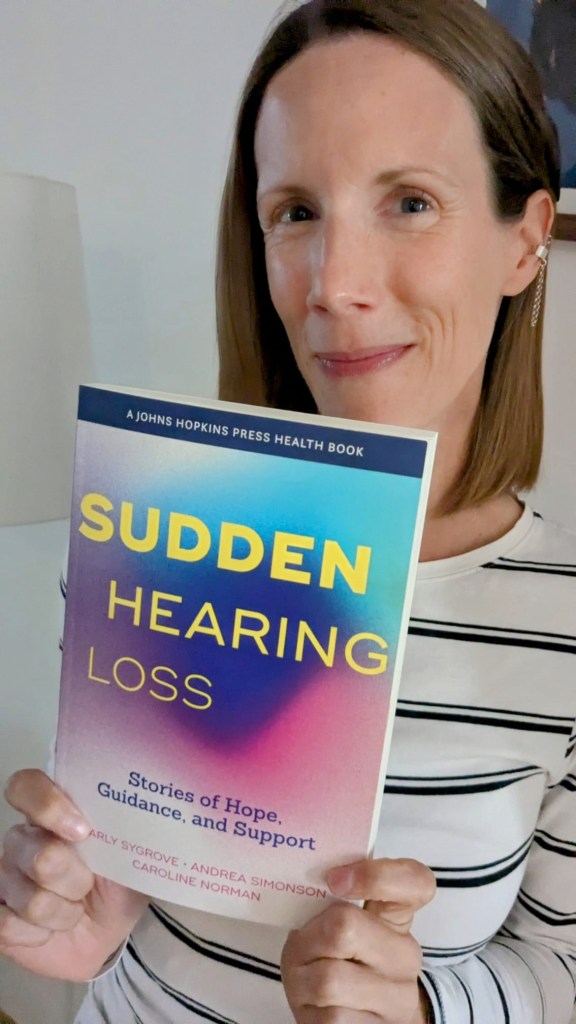
It was an incredible moment to finally hold the book in my hands. I co-wrote this book with audiologist Andrea Simonson and psychotherapist Caroline Norman to offer support to those experiencing sudden hearing loss. The book features real stories, expert advice, and practical guidance for anyone navigating this life-changing event.
I hope it provides comfort and strength to those affected, just as I continue to navigate this experience myself.
 My Hearing Loss Story
Great to hear your progress, you are doing so well.
Beep tests, stress and tinnitus, I feel your pain, you articulated it so well.
LikeLiked by 1 person
Thank you for following me on my hearing journey, Mark, and for the support.
LikeLike
Dear Carly so delighted to hear you are going from strength to strength with your hearing. Keep doing what you are doing and couldn’t be happier for you. With love from us both xxx
LikeLiked by 1 person
Thank you so much, Anita and Pete! I hope you are both well and happy in your new home ❤
LikeLike
Carly, your dedication to this process is admirable, yet not the least bit surprising. You have displayed this remarkable determination ever since I started following you (quite a few years now). So glad to see these successes. I think few of us could possibly realize how much work you have to put into this. Sharing it with others is the icing on the cake. Congrats on the book.
LikeLiked by 1 person
Hi Al! Thank you for your kind and encouraging words. You’re right – I have been putting a lot of work into learning to hear again. I feel so grateful to have been given the opportunity to have a cochlear implant for my single-sided deafness, and it’s wonderful to feel like I am gradually feeling more comfortable and included in my audio surroundings. Wishing you all the best!
LikeLike